Following the mighty oyster’s long journey from spat to shuck and what shapes an oyster’s flavor profile, texture, and appearance
If you’ve ever had an oyster platter, you might have noticed that each oyster tastes a little different. Maybe you’ve wondered how an oyster grown in Cape Cod Bay has a completely different flavor profile than an oyster grown on the Outer Cape. Farming methods, size, genetics, temperature, currents, seasonality, and processing all impact how we taste, shuck, and experience an oyster.
What defines how an oyster looks and tastes?
The term “meroir” refers to the influence of the surrounding ocean environment on the flavor profile of seafood, combining “teroir” (a French word used to describe how land shapes the taste of wine) and “mer” (the French word for ocean). There are even certification courses for oysters similar to sommelier programs. More oyster bars are starting to include oyster tasting education training for shuckers and servers. Many farmers have started using terms like “briny”, “vegetal”, or “creamy” to describe their oysters to prospective customers. You can even buy an oyster tasting journal created by oyster blogger and Sommelier Julie Qiu. So what shapes these differences in texture, appearance, and flavor profile?
First, it’s important to recognize that wild and farmed oysters are two completely different beasts. Both wild and farmed oysters are a reflection of their growing environment but wild oysters aren’t selected or cultivated for certain traits by humans. If you’ve ever had a wild Wellfleet oyster, you might notice that some are less meaty, they might be growing on top of each other, and their shells tend to be more fragile. Each wild oyster is totally different and they can be a lot of fun for more adventurous shuckers or foragers looking for a bolder flavor profile. You might opt to shuck a wild oyster from the side opposed to the hinge.
[Insert Oyster Farm Environments]
By contrast, farmed oysters are influenced by cultivation techniques, species, and location. While there are over 200 oyster species across the world, roughly a dozen species are commonly farmed. On Cape Cod, most farmed oysters are Eastern oysters (Crassostrea virginica) known for their briny flavor and teardrop shape. That being said, Eastern oysters have diverse genetics and have been selected for traits tailored to various growing environments. Seasonality, region, food (the type of algae and plankton an oyster eats), currents, growing method, and even storms have a huge impact on the development of a growing oyster. But to give farmed oysters a head start, most begin their life in a hatchery.
Oyster Hatcheries: Spawn to Spat
Like all shellfish, baby oysters begin their life as tiny larvae. Adult oysters (known as broodstock) are specifically selected for genetic traits such as cold hardiness, resistance to certain diseases, or their ability to grow fast. Some oysters are cultivated as triploid: with an extra chromosome that makes the oyster sterile but results in a faster-growing, fattier oyster.
[photo of triploid vs. diploid oyster]
In the hatchery, broodstock are held in warm water tanks with a buffet of algae until they spawn (which is usually induced by raising water temperatures). Once they spawn, eggs are fertilized in a highly controlled environment and eventually hatch into larvae. These larvae are tenderly handled for a few weeks. They’re fed just the right amount of food at just the right water temperature until they’re ready to latch onto a hard surface and become what we know as “spat”.In the wild, oyster larvae usually attach themselves to other oyster shells, forming wild oyster reefs. Hatcheries sometimes sell oyster spat on the shell (known as clutched production) or use a more intensive method known as cultchless production or single seed production. Cultchless production tends to be a bit more intensive and involves exposing the larval oyster to fine crushed sediment to induce the spat stage without attachment to a flat surface, resulting in a more uniformly shaped oyster.
[Image of hatchery/ upweller]
Oyster Farming Methods
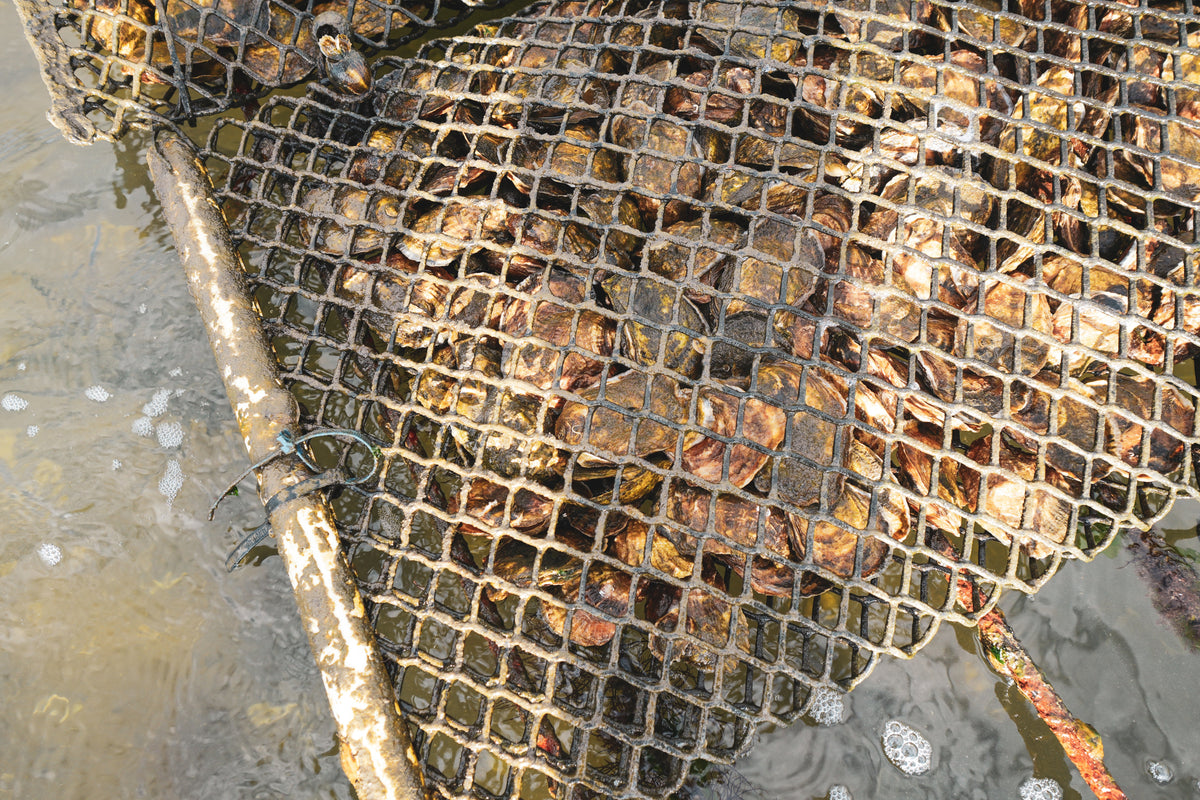
There are so many different ways to grow an oyster once a farmer receives their spat. Oyster growing environment, temperature, and predation all shape the type of farming method a farmer might use. For example, an oyster farmer might use bottom-culture (growing oysters on the ocean floor) in the spring to give baby oysters a burst of nutrients and oxygenated water but switch to floating culture once temperatures increase to avoid predation. Oyster farming is all about balancing chaos and control. Tidal exposure, ocean currents, and mineral availability are often what give oysters a distinctive brine, texture, and minerality. However, there are tradeoffs. A pampered oyster grown using safer, high-yield methods might taste bland, have a weak shell, and grow more slowly. Here we dive into the basics of different oyster cultivation methods and why farmers might opt for one method over another.
[Illustration - Farming Methods]
Bottom Culture: As one of the oldest oyster cultivation methods, bottom culture involves growing oysters directly on the seabed, sometimes in a substrate like shells or gravel. This method emulates their natural growing environment, where oysters are exposed to tides, lots of nutrients, seabed minerals, and algae. While bottom-culture tends to be a very cost-effective method of cultivating oysters, it also leaves them vulnerable to predation. Species such as the invasive green crab can easily sift through sediment to feast on growing oysters. Oysters also risk being buried by sediment. However, this phase can be key for flavor development, often resulting in an oyster with more “minerality”. Sometimes oyster farmers begin with bottom culture to give their stock a head start and shift to safer cultivation methods once the waters warm and predators become more active.
Off-Bottom Culture: Many oysters are raised or partially-raised above the seabed, resulting in a more controlled growing environment where oysters are less prone to predation or burial. Some of these methods include:
-
Suspended/ Longline: This often involves placing oysters in a bag and attaching each bag to a longline. This method can be more cost-effective than rack and bag methods and often maximises tidal exposure.
-
Rack and Bag: With rack and bag, each oyster bag has its own rack and rather than being hung vertically is positioned horizontally. Oysters are evenly distributed across the bag but depending on how high the racks are, they might still be vulnerable to predation from crabs, snails, or other climbing creatures.
-
Floating Culture: This method involves suspending oyster bags from floating buoys. It’s often considered the safest method for predator deterrence but can be costly and might not give the oyster enough tidal exposure.
Tumbling Oysters
Throughout the growing process, oysters are “tumbled” and tossed around in what looks like a mini version of a fun house tunnel. Without tumbling, oysters can have papery shells that are hard to shuck. Tumbling “trims” the outside of the oyster and can also help the oyster develop a stronger shell and deeper cup and emulates how an oyster might be tossed around in the wild.
Monitoring Oyster Temperature
As soon as an oyster is removed from the water for sale, it has to be kept cold with monitored temperatures. If oysters get too warm, they can cultivate harmful bacteria known as “Vibrio” that can get people sick. However, this bacteria can be easily purged by putting the oyster back in cold ocean water so that it “cycles” out the bad bacteria. States such as Massachusetts, New York, and Maine have strict Vibrio control plans with temperature monitoring protocols designed to keep people safe. Once you purchase oysters from the store, make sure to keep them at 32°F and 40°F (0-4°C) and keep in mind that consuming raw oysters may increase your risk of foodborne illness.
Hatchery to Plate
Oyster cultivation is a delicate science, combining millennia of cultivation techniques with modern innovation. From hatchery to plate, every step in the oyster supply chain requires meticulous attention to detail. The oysters we eat are entirely defined by where and how they’re selected, grown, processed, and handled. Next time you’re slurping down your favorite oyster, consider asking how it was grown and learning more about its story from hatchery to plate.